
Cultivating Sustainable Mindsets in Business Leaders
Now entering its third year, the partnership between Western Michigan University and GetGreen embeds the app directly into the Haworth College of Business curriculum — turning abstract environmental concepts into tangible, measurable habits for future business leaders.
Executive Summary
In collaboration with WMU's Office of Sustainability, GetGreen was customized specifically for the Bronco community. The result: hundreds of students taking thousands of real-world actions — proof that individual habits are the foundation of systemic business ethics.
The Challenge: Moving from Theory to Action
Business students readily grasp the macro-economics of sustainability — carbon accounting, supply chain ethics, corporate social responsibility — but translating those concepts into personal accountability is harder.
Dr. Timothy Palmer and Teresa Greenlees wanted their students to experience the friction, rewards, and reality of sustainable behavior firsthand. They needed a tool that could seamlessly integrate into their curriculum while providing data-driven insights into how individual choices drive broader cultural shifts.
The Strategy: A Tailored Campus Experience
GetGreen partnered with the professors alongside Jeff Spoelstra and the WMU Office of Sustainability to create a hyper-localized experience.
- Customized Action Items: The GetGreen app was populated with dozens of local, WMU-specific actions, letting students engage directly with campus infrastructure, local recycling guidelines, and regional conservation efforts.
- Deep Curriculum Integration: Rather than an optional extra-credit assignment, the app was embedded into two core courses:
- BUS 4500: Business Ethics and Sustainability (Undergraduate)
- MBA 6012: Sustainable Business Strategy (Graduate)
- The Reflection Loop: After tracking their daily habits, students completed academic reflections — analyzing the economic, psychological, and operational challenges of adopting a sustainable lifestyle.
The Impact: Sustainability by the Numbers
Over the course of the partnership, the collective impact of WMU business students has been immediate and measurable.
| Metric | Achievement |
|---|---|
| Active Participants | Hundreds of Undergraduate & MBA Students |
| Total Logged Sustainable Actions | 9,500+ actions completed |
| Partnership Longevity | Entering Year 3 |
Student Insights: In Their Own Words
The required course reflections revealed a profound shift in student perspectives. Experiencing behavioral change firsthand allowed future business leaders to empathize with the consumer frictions companies face when launching green initiatives.
"It made sustainability feel more manageable and less overwhelming."
"Being responsible for my actions created a sense of leadership."
— WMU Haworth College of Business students
Behavioral Insights Report — Spring 2026
Browse the full GetGreen Behavioral Insights report for WMU Haworth, Spring 2026, page by page below — or open it in a new tab.
GetGreen in Action at WMU
Looking Ahead: Scaling the Green Footprint
Following two incredibly successful years within the Haworth College of Business, GetGreen and Western Michigan University are expanding their horizons. As the partnership enters Year 3, the goal is to scale the app's customized framework beyond business courses — bringing GetGreen to the wider campus to foster a university-wide culture of daily environmental stewardship.
Download GetGreen for WMU and start logging actions today.

More partner stories
University of Miami — cultivating campus sustainability
3,000+ verified actions across students, faculty, and staff over three years of partnership.
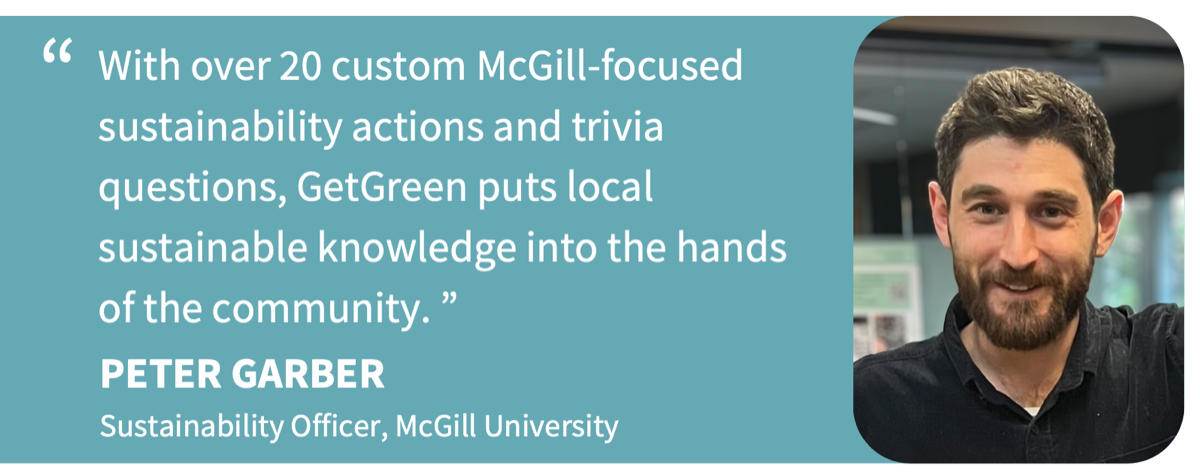
McGill Residential Cup — campus sustainability competition
15 residence halls competed, completing 2,500+ actions and avoiding 62.5 MT CO₂e.